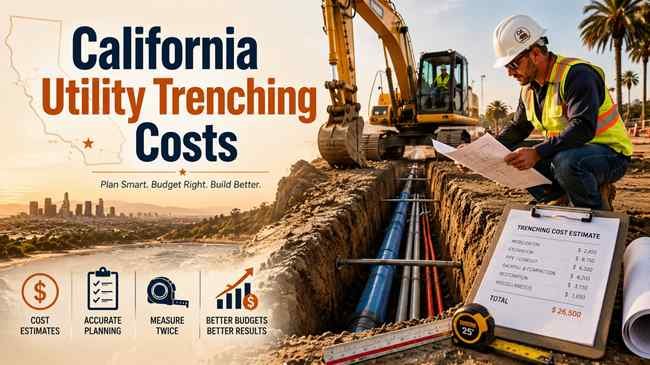
Utility trenching is the process of digging a long, narrow ditch in the ground to install underground pipes, electrical conduit, gas lines, or water service lines. It puts utility lines safely under the surface so they do not block traffic or get damaged above ground.
In California, utility trenching in plain dirt costs between $5 and $12 per linear foot. Cutting through asphalt or concrete pavement costs $12 to $30+ per linear foot. Large or complex projects can cost $18 to $36 per linear foot when surface repairs are included.
California has strict worker safety laws, underground utility marking rules, and local encroachment permit requirements. Because of this, your total price depends on soil type, surface material, trench depth, underground obstacles, and permit needs.
Key Facts to Know
- Dirt Trenching Rates: Standard dirt trenching in California costs $5 to $12 per linear foot depending on soil hardness and trench depth.
- Paved Surface Cuts: Saw-cutting asphalt or concrete roads adds 30% to 50% to your total project cost due to saw blades, base repair, and re-paving.
- Cal/OSHA Trench Permit: Any trench dug 5 feet or deeper that a worker enters requires a Cal/OSHA permit and a daily safety inspection.
- DigAlert 811 Law: California law requires calling 811 at least 2 working days before any digging to locate and mark public underground utility lines.
- Encroachment Permits: Work in a city or county right-of-way costs $300 to $2,000 in local permit fees before a shovel can touch the ground.
Complete Price Breakdown by Surface Type
Trenching costs change based on what type of ground or pavement you cut through. The table below shows expected prices across typical California project sites.
| Surface Type | What It Involves | Average California Price |
| Plain Dirt Trench | Digging through soft soil or loam | $5 to $12 per linear foot |
| Asphalt Pavement Cut | Saw-cutting blacktop and digging below | $12 to $24 per linear foot |
| Concrete Pavement Cut | Saw-cutting concrete and digging below | $15 to $30 per linear foot |
| Combo Dirt and Pavement | Mix of dirt and road surface cuts | $18 to $36 per linear foot |
| Rock Breaking | Using jackhammers or rock saws for hard soil | $30 to $70+ per linear foot |
| Surface Restoration | Patching asphalt or concrete after backfill | $8 to $25 per linear foot |
| Cal/OSHA Shoring System | Installing steel plates or wood lagging in 5+ foot trenches | $10 to $30 per linear foot |
| Total Estimated Budget | Complete Trench and Restore Project | $5 to $70+ per linear foot |
Per-Linear-Foot Trenching Cost Breakdown
Trenching contractors in California price work by the linear foot of trench dug. A linear foot is simply one foot of length along the trench path. Basic dirt trenching starts at $5 per linear foot and rises based on digging difficulty.
Trenching Cost Steps
- Utility trenching involves cutting a straight ditch of a set depth and width, placing conduit or pipes inside, backfilling with compacted dirt, and restoring the ground surface.
- Soft loam soil is easy to cut with a chain trencher machine. Dense clay or hardpan soil slows the machine down and requires more operator time per foot. When buried rock is found, contractors switch to jackhammers or rock saw attachments, which cost much more per hour to operate.
- Ask your trenching contractor to separate the base digging price per linear foot from rock removal surcharges. This prevents surprise line items at the end of the project.
Asphalt and Concrete Saw-Cutting Costs
Many utility trenches must cross driveways, parking lots, or public roads. Cutting through asphalt or concrete is much harder than cutting dirt. Surface cutting through roads adds 30% to 50% to your total project price.
Surface Cutting Steps
- Saw-cutting uses a large diamond-blade road saw to cut precise lines through asphalt or concrete before excavation begins.
- City inspectors require clean, straight saw cuts before issuing an encroachment permit for public road work. After the pipe or conduit is placed and the trench is backfilled, the road surface must be patched back to its original condition. Poor patching creates rough, unsafe road surfaces and can result in costly re-do orders from public works departments.
- Get a line item for saw-cutting and surface patching written separately in your contract. Confirm whether the patch is temporary (cold mix) or permanent (hot asphalt or concrete), since temporary patches often require a second visit and a final permanent repair.
Cal/OSHA Trench Safety Permits and Shoring Costs
California enforces strict worker safety laws for trench excavation. Any trench that is 5 feet deep or more and requires a worker to enter must have a Cal/OSHA permit and shoring protection. Shoring system installation costs $10 to $30 per linear foot of trench wall.
Trench Safety Steps
- Trench shoring uses steel hydraulic plates, wood lagging, or trench boxes to hold dirt walls from collapsing on workers while they install pipes or conduit.
- Trench wall collapses are one of the most deadly hazards in construction. A cubic yard of dirt weighs over 2,000 pounds. If a trench wall collapses on a worker, it can bury and suffocate them in seconds. Cal/OSHA requires a trained Competent Person to walk the trench every day before workers go in.
- Confirm that your trenching contractor has a designated Cal/OSHA Competent Person on staff before work begins. Make sure the contract includes daily trench safety inspection fees and shoring equipment rental costs.
Private Utility Locating and DigAlert 811 Requirements
Before any trench work begins in California, you must call 811 (DigAlert). This is required by law. Calling 811 tells public utility companies to come and mark the location of underground gas, water, electric, and phone lines on your property.
Utility Locating Steps
- DigAlert 811 is California’s free utility marking service. It sends utility company crews to spray paint or place flags on the ground showing where underground public utility lines run.
- Striking an unmarked underground gas line creates a dangerous explosion risk. Cutting a fiber optic cable can shut down internet service for thousands of homes. Private underground lines like irrigation systems, private electrical feeds, and in-ground gas lines are NOT marked by 811. Hitting a private line costs an average of $3,000 to $15,000 in emergency repair bills.
- Call 811 at least 2 working days before digging. Also hire a private utility locator who uses ground-penetrating radar (GPR) to find private underground lines that 811 does not cover.
Frequently Asked Questions
Trenching 100 linear feet in plain dirt costs between $500 and $1,200. If the trench crosses paved asphalt or concrete, the same 100-foot run can cost $1,200 to $3,000+ including saw-cutting and surface repair.
Yes. Any trench 5 feet or deeper that a worker enters requires a Cal/OSHA permit. Work in a city street or public sidewalk also requires a local encroachment permit from your city or county public works department.
Standard depth requirements vary by utility type. Electrical conduit typically requires at least 18 to 24 inches of cover. Water lines usually require 18 inches. Gas lines require 24 inches. Depth rules vary by local utility company and city code.